
In the landscape of Nigerian agro-processing, value addition is the ultimate driver of agricultural profitability. Among the various processing technologies available to local fabrication engineers and agro-processors, the hammer mill stands out as the absolute workhorse of the food engineering sector. Whether crushing dried corn kernels into fine maize flour or reducing high-quality cassava chips into flour, industrial hammer mills provide the mechanical impact necessary to meet both local market demands and industrial standards.
However, processing grains like corn and tubers like cassava requires completely different mechanical adjustments, moisture considerations, and screen configurations. Operating a mill without understanding these distinct processing variables leads to rapid screen blinding, high thermal degradation of the starch, or premature hammer wear. This comprehensive engineering guide breaks down the precise mechanics of hammer mill processing for both corn and cassava flour production.

1. The Core Mechanical Principles of a Hammer Mill
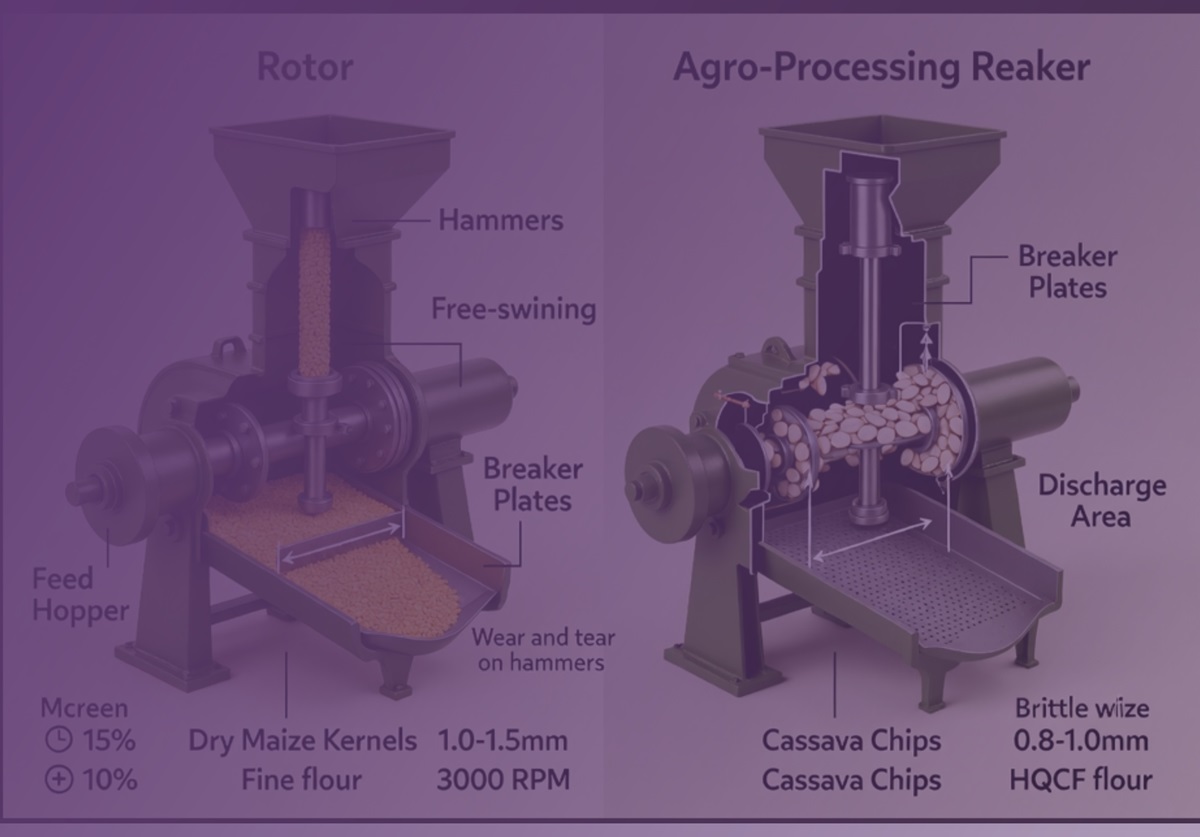
Before exploring specific crop processing, it is vital to understand the physics governing the machinery. A standard industrial hammer mill operates on the principle of impact grinding rather than compression or shearing. The reduction process relies almost entirely on kinetic energy transfer from the rapidly moving components directly into the cellular walls of the feedstock.
The machine consists of four primary components:
- The Rotor Assembly: A central shaft rotating at high speeds (typically between 2,800 and 3,600 RPM) driven by a high-torque electric motor or a diesel prime mover.
- The Hammers: Free-swinging high-carbon steel plates attached to pins on the rotor. Their free-swinging design protects the shaft from snapping if an uncrushable foreign object enters the chamber.
- The Striking Plates (Breaker Plates): Heavy-duty, corrugated steel walls inside the milling chamber that provide a secondary impact surface for primary fractures.
- The Screen: A perforated metal sheet wrapped around the lower half of the chamber that dictates final particle size distribution.
When material enters the feed hopper, the fast-moving hammers shatter the material mid-air and throw it against the breaker plates. The material undergoes continuous impact fracture until the particle diameter is smaller than the screen perforations, allowing it to discharge via gravity or pneumatic suction.
2. Processing Corn (Maize) Flour: Precision Parameters
Corn milling is categorized by high friction and a need for precise particle uniformity to separate the bran, endosperm, and germ if high-grade flour is required. The physical density of a dry maize kernel demands aggressive impact force to achieve a clean shatter pattern without producing excessive dust fractions.
Dry vs. Semi-Wet Milling
For standard local maize flour, a dry milling approach is used. The moisture content of the corn must be strictly monitored using a digital moisture meter:
- Optimal Moisture Baseline: Between 12% and 13.5%. This balance ensures the kernel is brittle enough to fracture cleanly under impact.
- The Risk: If the moisture exceeds 14%, the internal starch becomes elastic, absorbing the hammer impacts instead of shattering. This leads to friction-induced heat buildup, grease binding on the hammers, paste accumulation, and rapid clogging of the screen holes.
Mechanical Configuration for Corn
Rotor tip velocity needs to remain highly accelerated. The system should be calibrated toward its higher threshold limit (3,600 RPM) to ensure clean shatter fractions of the hard vitreous endosperm. A 1.0mm to 1.5mm stainless steel perforated screen is standard for fine local flour, while a 2.0mm variant is swapped in for coarser confectionary grits or local meals.
3. Processing Cassava Flour (HQCF): The Moisture Challenge
Processing cassava into High-Quality Cassava Flour (HQCF) presents an entirely different biochemical and mechanical challenge compared to corn. Cassava is a heavy root tuber consisting of pure starch granules locked within a dense, fibrous matrix.
The Mandatory Pre-Milling Protocol
You cannot feed raw, wet cassava directly into a standard hammer mill without turning the chamber into a sticky, gelatinized paste. The cassava must undergo a rigorous preparation pipeline:
- Peeling and Washing: Removing the outer cortex to reduce cyanide levels and soil contaminants.
- Grating and Pressing: The roots are reduced to a fine mash using specialized high-speed machinery to optimize starch release. For a deep engineering breakdown of this phase, review our guide on The Mechanics of Cassava Grating Machines: Design, Maintenance, and Common Faults. After grating, the pulp is placed in hydraulic press units to mechanically force out the bulk water content.
- Drying: Sun-drying or flash-drying the resulting cassava cake until the moisture drop drops sharply to a maximum of 10% to 12%. The dried product forms highly brittle "cassava chips."
💡 Step-Back in the Processing Chain: Operating an efficient mill relies heavily on how well the raw roots were prepared during the grating stage. Learn how to maintain your root processing equipment and fix alignment issues by visiting our technical analysis: The Mechanics of Cassava Grating Machines: Design, Maintenance, and Common Faults.
Mechanical Configuration for Cassava Chips
Once the cassava chips are completely brittle, they are fed into the hammer mill hopper. Because cassava is highly abrasive due to residual fibrous strands, the free-swinging hammers must be fabricated from hardened materials like hard-faced medium carbon steel to prevent rapid tip erosion. A 0.8mm to 1.0mm screen is typically deployed to ensure the flour meets strict industrial baking specifications.
4. Discharge Engineering: Gravity vs. Pneumatic Evacuation
A major bottleneck in local mill fabrication is the method used to clear milled flour out of the chamber. If the flour lingering inside the mill isn't evacuated instantly, it undergoes double-milling, creating excessive heat that ruins the baking properties of both corn and cassava starch.
- Gravity Discharge: Material falls directly through the bottom screen into a collection bag. While cheap to fabricate, it relies completely on the kinetic energy of the hammers to push material through. It is prone to clogging when running ultra-fine 0.8mm screens.
- Pneumatic Fan System: A dedicated centrifugal blower fan pulls air through the milling chamber. This constant vacuum draws out the fine particles the millisecond they pass the screen, dropping internal temperatures by up to 15°C and increasing overall hourly output by 30%.
5. Mechanical Comparison Matrix
| Processing Parameter | Corn (Maize) Milling | Cassava (HQCF) Milling |
|---|---|---|
| Raw Material State | Whole, de-stoned dry grains | Peeled, pressed, and dried chips |
| Critical Moisture Cap | 12% - 13.5% | Max 12% (strictly monitored) |
| Target RPM Threshold | High (3,200 - 3,600 RPM) | Medium-High (2,800 - 3,200 RPM) |
| Primary Machine Strain | Heat buildup & starch thermal damage | High component erosion from fiber |
| Standard Screen Gauge | 1.0mm - 1.5mm | 0.8mm - 1.0mm (Ultra-fine) |
6. Maintenance & Troubleshooting Technical Protocols
To prevent costly operational downtime and component failures, plant operators must execute systematic mechanical oversight based on these three key parameters:
- Hammer Reversal Matrix: Hammer edges wear down into a rounded shape over time, dropping milling efficiency by up to 40%. Because hammers are symmetrical, operators should open the chamber weekly and reverse the plates to utilize the sharp trailing edge before replacing the entire set.
- Dynamic Rotor Balancing Check: Even a minor weight variance between hammer groups (caused by uneven wear) introduces massive centrifugal vibrations across the main shaft. This vibration will rapidly destroy the heavy-duty pillow block bearings housing the rotor. Always weigh replaced hammers in balanced, matching pairs.
- Diagnosing Screen Blinding: If your output drops sharply while engine RPM remains constant, the screen pores are choked. This is usually caused by processing corn or cassava with moisture levels above 14%. Shut down the mill, isolate the power source, remove the screen, and clean the pores with a stiff wire brush before restarting operations.
By matching the physical attributes of corn and cassava to the correct mechanical parameters of the hammer mill, local processing plants can dramatically increase their hourly output capacity, lower utility consumption, and manufacture top-tier flour products that compete cleanly on national market scales.
Comments (0)
No comments yet. Be the first!
Please login to leave a comment
Login to Comment