
The Ultimate Drying Dilemma: Should You Go Solar or Stick to Charcoal?
A brutally honest look at the thermodynamics, hidden running costs, and real-world headaches of local dehydration technology.
If you have ever watched a massive batch of freshly harvested cassava chips, sliced plantains, or beautifully harvested ginger go bad right before your eyes because a sudden downpour ruined your open-air drying, you already know the heartbreak. Post-harvest loss isn't just a boring statistic found in agricultural textbooks; it is a direct hit to your pocket, your hard work, and your business runway.
We all know that leaving your hard-earned produce spread out on tarpaulins by the roadside is a massive gamble. Between the random dust storms, neighborhood goats, flies, and unpredictable clouds, you are essentially playing roulette with your food quality. But let's be honest: turning on a massive commercial electric dryer isn't the answer either unless you have a personal power plant or love paying terrifying electricity bills. That is exactly why local fabricators have stepped up to build two of the most popular, off-grid solutions on the market today: Locally Fabricated Solar Dryers and Charcoal-Heated Cabinet Dryers.
But here is the real question you are facing: Which one actually delivers when your business is on the line? Let’s strip away the marketing fluff and look at the actual engineering, everyday realities, and dollars-and-cents math behind both choices so you can make a choice that actually scales your business.

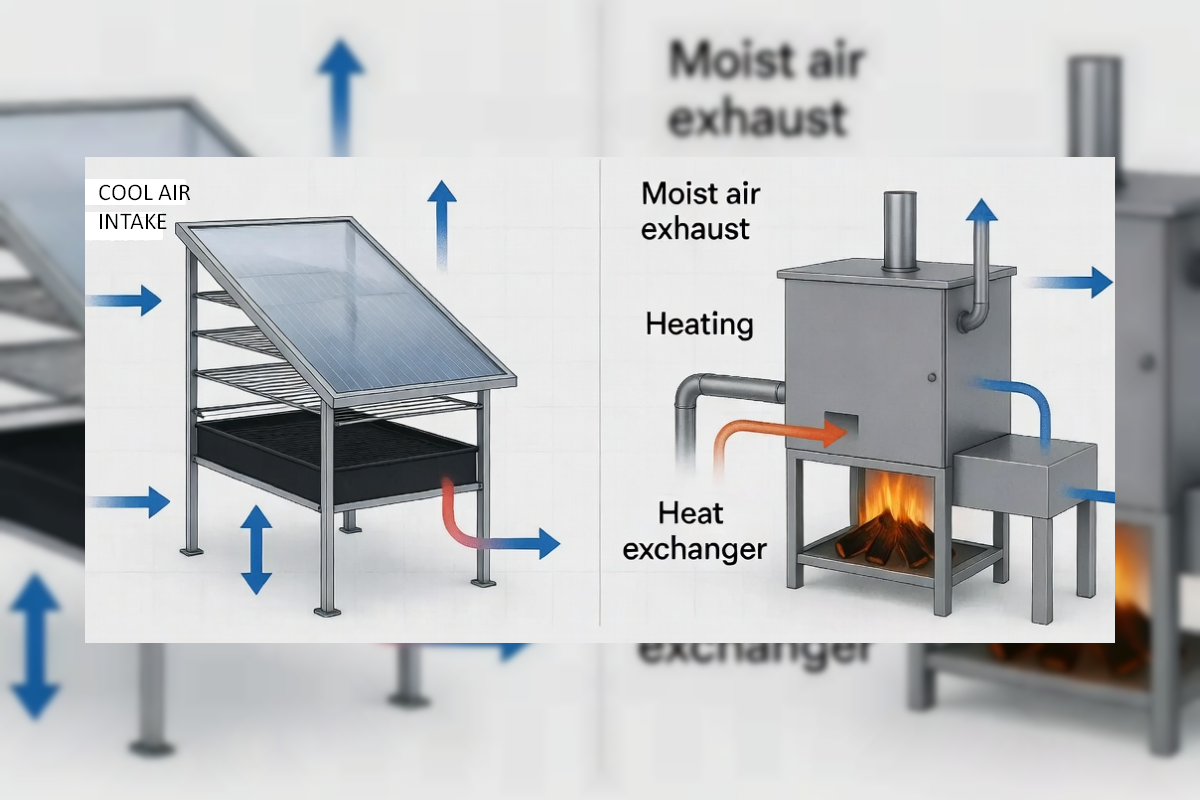
Real-World Side-by-Side Blueprint: Tracking how fresh air enters, heats up, and carries moisture away in both solar and charcoal chambers without ever exposing food to soot.
The Solar Dryer: Capturing Free Heat (With a Catch)
Imagine a miniature, heavy-duty greenhouse sitting right in your yard. Local solar dryers are beautifully simple machines built from sturdy wooden frames or square metal pipes, wrapped tightly in clear polycarbonate sheets or thick, UV-stabilized plastic glazing. Inside, the bottom and back walls are lined with sheet metal painted matte black.
The science here is brilliant: shortwave sunlight punches right through the clear plastic cover and slams into that black metal lining. The metal absorbs the energy and spits it back out as longwave infrared heat. Because this heat can't escape back through the plastic, it gets trapped, easily driving internal temperatures up to a sweet spot between 50°C and 65°C.
As the air heats up, its humidity plummets, turning it into a literal moisture sponge that sucks water right out of your produce. In basic passive models, that hot, wet air naturally rises out of vents at the top while pulling fresh, dry air in from the bottom. If you upgrade to an active model, your fabricator adds a tiny 12V extractor fan powered by a small solar panel. This forces the humid air out even faster, slashing your total drying time by nearly a third. The best part? Your running cost is a flat, beautiful $0.00 per hour.
The Charcoal Cabinet: Pure Power, Whenever You Need It
Now, let’s talk about the heavy lifter. A charcoal-heated dryer doesn’t care about the weather, the clouds, or what time of day it is. It is essentially an insulated metal vault with a robust combustion chamber engineered at its base. You fill the firebox with charcoal, light it up, and let the thermal energy do the work.
But wait—won't your food smell like smoke or get covered in ash? Not if your fabricator knows what they are doing. A high-quality local build features a completely sealed heat exchanger matrix. The smoke and toxic combustion gases stay entirely inside an isolated network of thick metal pipes that exhaust straight out of a chimney. Meanwhile, fresh, clean air from the outside passes over the blistering hot exterior of those pipes, heats up perfectly, and flows evenly through your food trays.
Because charcoal burns incredibly hot, these cabinets easily maintain steady temperatures between 60°C and 80°C. You can adjust the airflow via manual intake dampers to keep things precise, allowing you to dry massive batches back-to-back with total control over your production schedule.
The Right Tool for the Right Crop: Matchmaking Your Produce
Different agricultural products react uniquely to thermal shifts. Choosing a dryer without matching it to your specific crop profiles can lead to case-hardening (where the outside dries into a brick wall but the inside stays raw and wet) or color degradation.
Root Crops & High-Starch Chips (Cassava & Yam): These are incredibly resilient but hold massive volumes of structural water. Because you want to process these in huge bulk volumes quickly to hit market windows, the intense, high-heat environment of a Charcoal Cabinet is incredibly efficient here. It drives down moisture content to the required 12% baseline before mold can even think of forming.
High-Value Spices & Aromatics (Ginger, Chili Peppers, & Turmeric): Spices are valued heavily for their volatile oils and vibrant colors. If you blast ginger or peppers with 80°C charcoal heat, you burn off the essential oils, ruining the flavor profile and bleaching out the rich color buyers look for. For these delicate crops, the **Solar Dryer's** gentle, moderate temperature curve acts as a natural preservation chamber, locking in the aromatic properties beautifully.
The Honest Breakdown: Solar vs. Charcoal
When you are trying to scale your agro-processing business, you have to weigh free energy against absolute dependability. Let's see how they stack up side by side:
| The Factor | Locally Fabricated Solar Dryer | Charcoal-Heated Cabinet Dryer |
|---|---|---|
| Working Hours | Strictly daytime. If it's 2:00 AM or pouring rain, your drying stops completely. | 24/7 continuous output. Midnight or rainy season, you keep moving. |
| Running Costs | Absolutely zero. The sun doesn't send you a monthly invoice. | Ongoing expenses. You are tied to the local market price of charcoal bags. |
| Drying Speed | Gentle and steady. Perfect for keeping delicate vitamins intact. | Fast and intense. High heat gives you rapid batch turnarounds. |
| Food Protection | Flawless. Sealed sheets keep out all dust, birds, and pests. | Excellent, provided the heat exchanger is built perfectly airtight. |
The Real-World Economics: Counting the Hidden Costs
Let’s talk money. A solar dryer has a higher initial setup footprint relative to its drying speed because you need a wider surface area to catch the sun. However, its long-term financial curve is incredibly friendly. Once paid for, your operational profit margins skyrocket because your input fuel cost remains absolute zero.
On the flip side, a charcoal cabinet is compact, fast, and relatively inexpensive to construct. But it introduces a recurring cost element to your balance sheet. During peak harvest seasons, if your facility is running three batches a day, your charcoal expenditure can quickly eat into your raw profit margins. You must calculate your local cost per bag of charcoal against the premium price your dried produce fetches in the market to ensure your unit economics stay firmly in the green.
The Best of Both Worlds: If you hate compromises, ask your fabricator about a hybrid system. These clever designs run entirely on free solar energy during the day,but feature an integrated charcoal firebox you can light at night or during heavy storms to keep your production running non-stop.
Don't Get Cheated: 3 Quality Checkpoints Before You Buy
Before you hand over your hard-earned money to a local welder or blacksmith, bring this checklist to the workshop to make sure you're getting a premium, long-lasting build:
- Look Closely at the Trays: The meshes holding your food must be food-grade stainless steel or safe wood slats. Reject cheap galvanized iron or standard mosquito netting immediately. They will easily flake off zinc or leach chemical toxins straight into your produce under high heat.
- Knock on the Walls (For Charcoal Models): A premium charcoal cabinet must be double-walled and packed with insulation like fiberglass wool or dense, processed agricultural hulls. Without this insulation, your cabinet will bleed massive amounts of heat into the room, wasting your charcoal and turning your workshop into an oven.
- Check the Roof Angle (For Solar Models): Look at the slope of the clear plastic roof. It needs to be angled at a minimum of 15 to 20 degrees. If it is too flat, internal humidity will pool on the ceiling and drip right back down onto your drying food ruining your batch and creating a breeding ground for mold.
What specific crop are you processing right now, and are you leaning toward the zero-cost operation of a solar setup or the sheer, unstoppable dependability of a charcoal system?
Comments (0)
No comments yet. Be the first!
Please login to leave a comment
Login to Comment